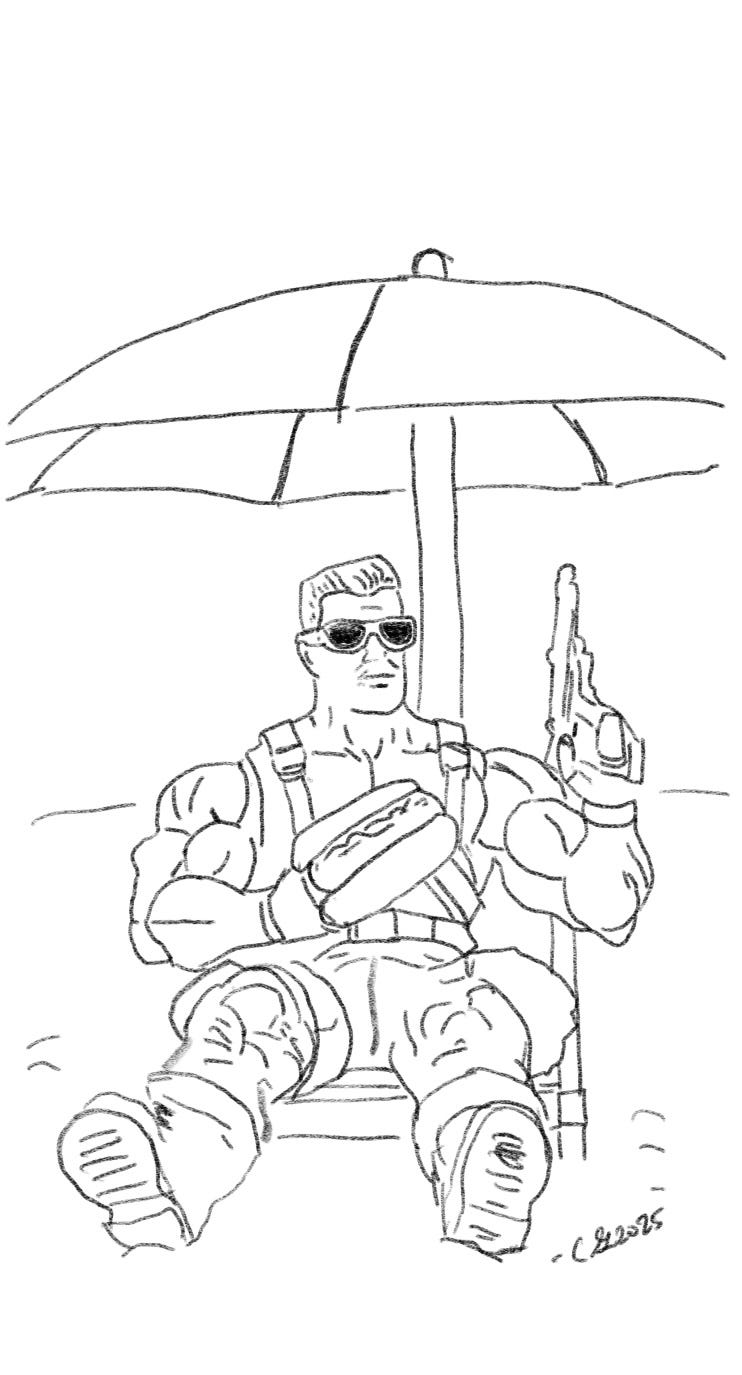
Part 2: The Quality Fallacy
The Rise of Slot Machine AI Prompting and the Erasure of Creative Intent

Author’s note: this is a series on The High Cost of Cheap AI Art. Click here for Part 1.
Kevin is 23 years old. Until last week, his job title was Social Media Coordinator, which mostly involved replying to angry tweets with GIFs. But thanks to the new efficiency mandates, Kevin has been promoted. He did not receive a raise, but he did receive a new title: Director of Generative AI. Kevin is now, effectively, the entire Marketing Art Department for Omni-Toy Global.
His first assignment is the high-stakes launch of the “Commando Kyle: Summer Fun” campaign.
The brief from the VP is simple: “We need a high-energy image of Kyle storming a beach. Needs to feel tactical but also fun. Like, he’s defending freedom, but he’s also ready for a barbecue. Make it viral.”
In the old days, a team of artists would have posed the 3D model, set the lighting to highlight the sculpting work, and hand-painted the background to ensure the perspective matched.
Kevin, however, opens Asset-Gen 9000.
He cracks his knuckles and types: “Commando Kyle action figure, storming a beach, holding rifle, summer vibes, explosion in background, hyper-realistic, 4K, trending on ArtStation.”
The computer whirs. The progress bar spins. Kevin holds his breath.
The image appears.
At first glance, it’s impressive. The lighting is dramatic. The ocean spray is photorealistic. The colors are vibrant.
But then, Kevin leans in.
The Rifle: Commando Kyle is holding his signature CAR-15 carbine, but halfway down the barrel, the gun dissolves into what appears to be a pool noodle.
The Hands: Kyle’s left hand is perfect. His right hand, however, is a fleshy catcher’s mitt of six fingers, one of which is merging with the trigger guard.
The Vibe: In the background, there is a dog playing volleyball. But the dog is floating three feet off the ground, and the volleyball is the size of a watermelon.
“Okay,” Kevin mutters. “Too abstract.”
He tries to refine the prompt. “Fix hands. Make gun metal. Dog on ground.”
The AI generates a new image. Now the hands have four fingers, but the gun is bending 90 degrees like a boomerang. The dog is gone, replaced by a seagull with human teeth.
Kevin sighs and types again. “Negative prompt: birds. Positive prompt: straight rifle barrel.”
The computer thinks. It produces a new image. The bird is gone, and the gun is straight. But now, for some reason, Commando Kyle is wearing a tuxedo top with combat boots.
Kevin enters the Prompt Loop, a casino trance of the desperate.
“Remove tuxedo, add tactical vest.” The AI complies, but now the ocean is made of blue Gatorade.
“Photorealistic water.” The water looks perfect, but Kyle’s left leg is now backwards at the knee.
“Fix leg.” The leg is fixed, but the gun is a noodle again.
The afternoon dissolves into a blur of loading bars and progress spinners. The sunlight tracking across his desk fades to grey, then to the harsh fluorescent buzz of the empty office.
Kevin looks at the clock. It is 8:30 PM. He has generated 400 images. They all look “almost” right, which is another way of saying they are all completely wrong.
Just then, the VP walks by. He glances at Kevin’s monitor. He sees the bright colors. He sees the Summer Vibes. He doesn’t zoom in to count the fingers or examine the seagull’s dentistry.
“Wow,” the VP says. “That fidelity is incredible. And that cost us zero dollars? Ship it.”
Kevin swallows hard. “But sir, the gun looks like a noodle...”
“It’s an aesthetic choice,” the VP says, walking away. “It’s stylized. The kids love stylized.”
Kevin uploads the image to the main website. He feels dirty. He knows that in ten minutes, the Reddit forums are going to tear him apart.
The Economic Reality:
When I was first embedded in a game studio early in my career, I was assigned to a dark, windowless office shared with two animators. The location was chosen on purpose: so I could learn exactly how much labor goes into “effortless” art.
I watched them work for hours on a 3-second reload animation. I learned that when a human artist draws a hand, they are making a thousand micro-decisions based on anatomy, physics, and weight. They understand why the thumb grips the rifle. They understand the tension in the forearm.
Asset-Gen 9000 understands none of that. When an AI generates a hand, it is simply predicting the statistical probability of a beige pixel appearing next to another beige pixel. It has no concept of bone structure; it only has a concept of Beige Probability.
This leads to The Quality Fallacy: the mistaken belief that consumers cannot distinguish between generated content (statistical prediction) and created content (human intent), provided the resolution is high enough.
The market may not self-correct immediately, because executives are currently deluded by short-term cost savings, mistaking Minimum Viable Product (a reduction in scope) for Minimum Viable Quality (a reduction in standards). Consumers say they hate AI art. They actually hate any art that is derivative and poorly executed. Video games are a purely visual medium. A derivative product signals to the customer that the creator no longer cares, instantly devaluing a brand that took decades to build.
This is the reality policymakers need to understand. They are told AI is a magic efficiency box that removes drudgery. My counter-narrative is that for people like Kevin, AI creates a new, frustrating type of low-value labor: Slot Machine Prompting.